Showing posts with label nonfiction. Show all posts

Friday, November 4, 2016

The Sound of Gravel


The Sound of Gravel: A Memoir, by Ruth Wariner
Published January 5, 2016 by Flatiron Books
Rating: ★★★★★

Holy Moses, this book just about destroyed me.

This book isn't a TLC show, and readers going into with a certain sense of schadenfreude about polygamist compounds are going to be disappointed. In the end, this is a tale of what happens when people pursue selfish desires (like religious fervor, ideological purity, and attention from a lover) over the well being of their children. The themes that prevail throughout this book hit a lot closer to home than LeBaron, Mexico.

LeBaron is the remote location Ruth Wariner's grandfather, Alma LeBaron, chose as the home for his polygamist cult. The Firstborns, as the group becomes known, believed the modern Mormon church had lost its way, and that polygamist marriage was one of God's most important decrees, as well as the only path to salvation. They refer to the United States as Babylon, and they feel God will sweep down from the heavens any day now to smote it. No surprise the group feels safer in Mexico-- and it doesn't hurt that government officials down there turn a blind eye to their polygamist and child bride practices.

Ruth never knew her father, who was at the time of his death considered the great prophet of the church. He was murdered just months after she was born, at the hands of his own brother in a family-feud-turned-holy-war. Her mother remarries her stepfather, Lane, and Ruth never ever feels comfortable around him. Her young instincts will turn out to be devastatingly correct.

Life is always turbulent as Ruth grows up. Her mother and Lane fight a lot, and Ruth can't understand why her mother keeps having babies with him. Unfortunately, several of Ruth's siblings have mental and physical disabilities of varying degrees. It's not an easy challenge to face in any situation, but Ruth's family also has the burden of being dirt poor and living area with no doctors and no social services. They struggle to survive without even the basics-- no electricity or indoor pluming, no telephone, inadequate food. Her family moves around a lot-- in one hovel more cramped than the next-- and when they are in Mexico, they still have to come back to the US frequently to claim benefits. As a "single mother," Ruth's mother collect food stamps and other types of taxpayer aid. The Firstborns see nothing wrong with living off the teat of Babylon.

I was definitely left with mixed feelings about Ruth's mother. You could tell she loved her children, but she wasn't willing to fight for them when it counted. It seemed like the more children she had, the more pressure put on her by the polygamist compound lifestyle, the more she lost her free-thinking spirit. It's hard to understand why she put so much faith in Lane when he made a fool of her time and time again, and why she didn't protect her children more. But then I have to wonder she owned total responsibility for her actions when she was so brainwashed and beat down.

Through this tumultuous tale, it becomes ever more clear that Ruth is a survivor. She endures more suffering and loss than most and does so with admirable strength. By the end of the book, I was at the edge of my seat, waiting to see if she would escape the cult. I don't think I've come across a memoir where I felt so invested in seeing the author getting a happy ending. I highly recommend this.

Friday, October 7, 2016

Coming Clean


I don't normally post reviews for books published this long ago, but with this being available on Amazon's new Prime Reading, I thought it was appropriate. Also, I liked this book a lot, and wanted to share it.

Coming Clean, by Kimberly Rae Miller
Published July 23, 2013 by New Harvest
Rating: ★★★★

For a book about a child growing up in a hoarding environment, I found this to be surprisingly tragic. Like many others, I'm addicted the popular tv shows that feature, and some might argue exploit, this mental health issue. If you look around online, it's not hard to find articles and forum comments that are very judgmental, and often times vicious, toward the people who appear on these shows. It's not uncommon for viewers to suggest that watching Hoarders is inspiration to clean their own homes. It's easy to forget that these are human beings-- not motivational tools.

Kimberly Rae Miller puts a very human face on the issue of hoarding. Her father has no memories of his childhood, at all. His parents were hard-core alcoholics and whatever happened to him in his youth was protectively erased by his brain. Her mother grew up unloved by neglectful parents. She suffers with an extreme spinal condition because her parent's couldn't be bothered to get her a back brace as a child. Kimberly's father starts as the catalyst for the hoarding situation. He's fond of papers, any paper, and radios. Their house quickly fills of them. Her mother is angry at the mess, but also ultimately resigned to it. She eventually becomes a compulsive shopper who adds to the hoard.

The hoard slowly takes over the family's life. Their first house burns down in a fire, spurred on by the mounds of paper, killing all the family pets. Her parents separate for a time, partly to keep CPS from discovering their true living conditions. The boiler explodes, and they have to start taking weekly showers at a local gym. Then they discover a surprise living in their attic, the reveal of which literally had me screeching at my Kindle.

This is a very well-written memoir, better than many I've read from professional writers. The author is likable and down to earth. I think some people will be confused, maybe even put off, by her forgiving nature to her parents. But I get it. My interest in hoarding actually comes from my husband's family-- both he and his mother have hoarding tendencies. Yet, I grew up in a dysfunctional environment, and I could relate to every inner struggle with her parents. I wish her the best of luck going forward and dealing with her parents as they continue to age.

Wednesday, October 5, 2016

Why Not Me?


Why Not Me? by Mindy Kaling
Published September 27, 2016 by Three Rivers Press
Rating: ★★★★


If there were such a thing as celebrity soul mates, I'd like to think mine would be Mindy Kaling. Because that's the kind of person Kaling is: graduate of an Ivy League college, writer/actor for two successful tv shows, author of two books... and so down-to-earth that a yokel like me can think, "yeah, sure, we could totally be friends." Because Kaling for sure has nothing better to do than call me up and vent over why no one has thought to make a hair iron with auto shutoff (Kaling's number one fear is accidentally having left hers on-- hear, hear).*

I read Kaling's first book, Is Everyone Hanging Out Without Me?, and I think her second effort is better. One thing she didn't devote much page space to is body image-- or rather the media obsession with her shockingly average figure and the expectation that Kaling be an ambassador of body positivity just for daring to appear on television while a size 10.

"If I were your doctor or your congresswoman or your sandwich artist, you wouldn't be shocked to see me, and yet, because I'm an actress, a grown man was amazed that I put jam on my toast."

A lot of Kaling's writing is irreverent, random, but entertaining and relatable. She worries that her Uber driver is a serial murderer, and wonders if all the hair she pulls out of her shower drain means she's on the fast tract to wigsville. She can't sleep because she's fretting over the early-stage cancers that could be living inside her, undetected. She takes a theater-hating friend to the theater and expects the evening to end with a thank you gift. She imagines what her life would be like if she had become a Latin teacher and writes romantic comedies starring her alter ego.

I could live without the dating escapades that seem required of these types of memoirs. Kaling's outlook on romance and dating is cringe worthy. While Kaling aspires to write the next great romantic comedy, I think what this book proves is that her real genius is in brilliant one liners and self-aware satire.

"My sense of humor is loud and wet and risque, like topless day at the water park."

Kaling also wants you to know that she works hard. Really hard. And she has a message for America-- even mothers. It's ok to work really hard. And if you want to inspire confidence in your daughter, you should focus on her work ethic. 

"It's just that, the truth is, I have never, ever, ever met a highly confident and successful person who is not what a movie would call a 'workaholic.'"

This isn't exactly a life changing book, but it's fun, and heads and tails above its many competitors in the suddenly crowded female-comedy-writer-who-struggles-to-find-husband memoir genre.


* I have made my husband turn around the car more times than I can count because I'm worried I've left on the hair iron. Seriously, people, auto shutoff. Someone get on this.

I received a copy of this book courtesy of Blogging for Books. It did not effect my review in any way.

Monday, October 3, 2016

The Lion in the Living Room


The Lion in the Living Room by Abigail Tucker
On Sale October 18, 2016 from Simon & Schuster
Rating: ★★★★


Don't be fooled. Your precious Fuzzykins is a barely-domesticated hypercarnivore who is probably hypnotizing you with its parasite tainted urine-- when not busy hunting endangered species into extinction.


Hmmm. I might need a bit more convincing.

"Many cat lovers, pondering their blind devotion to a savage little archcarnivore, privately wonder if they might be just a little touched in the head."

Well, as a life-long cat lover, I can honestly say I have never wondered this. But author Abigail Tucker did and set out to discover just why people-- including herself-- are so crazy for cats. What caused her to stay awake at night worrying that someone might kidnap her ginger tomcat Cheetoh and what she might be willing to pay as ransom? Why are we so fascinated with internet cat videos? Why do we desire to surround ourselves with this creature-- both in animal and consumer product form (cat pillows, cat mugs, ect.)?

Why am I about to fill this review with cat gifs?


Tucker's research takes her to places that might unnerve cat enthusiasts. In a sense, cat lovers talking about cats is supposed to be a "safe space." A place where being a cat lady is a badge of honor. A place free from that co-worker who stops by your desk each week to smugly remind you how much she hates cats-- while looking at a picture of your cat. So I think there's an expectation that a book about cats will take a feline friendly tone tell us all the things we want to hear about our fluffy friends. And this expectation only grows stronger as cats have become "cool," and cat people have come out from the shadows.

So, in contrast, this book just seems so negative. According to the wildlife preservationists Tucker interviews, cats are an "ecological axis of evil," who are single-handedly wiping species off the earth. Yet, at the same time they are horrible mousers, and thus don't provide any true benefit to humans like dogs do (I'll remember this next time I see my neighbor dragging his fat pug down the block). Cats spread toxoplasmosis, a parasite that causes birth defects and basically eats your brain. It also might hypnotize you into irrationally liking them. And cause schizophrenia. Cats are tricky devils who figured out what no other species did-- that hitching their wagons to humans would improve their outcome. Which means cats are in our homes and our lives on their terms. They could leave at any time and be just fine without us.

Pretty much all my reading is done with Hot Fudge Sundae, my dim-witted but infinitely snugly tuxedo cat, curled up beside me. And while I was reading this book, I looked down, meeting her deep amber colored eyes and thought: "why are you trying to kill me?"

It's best to take Tucker's writing with a grain of salt. After all, it seems illogical to blame cats for hunting endangered species, when said species became endangered in the first place due to human habitation, deforestation, ect. The claim that the rise of insanity corresponds with keeping cats as pets ignores that the same time period corresponds with emerging concepts about mental illness.

My favorite chapter had to be "Pandora's Litterbox," where I learned that I am "cat-shaming" my feline by not having a cat friendly living room layout. Poor Hot Fudge Sundae! I pretty much died reading about Doug, the cat owner who moved out of his 400 sqf master bedroom and onto the couch so his pet could have "personal space." No worries though-- he's allowed to sleep over in the cat's room a couple nights each week.

This book was a bit of a mixed bag for me, but over all I enjoyed it. Because, you know, cats. And with that, I'd like to close out with my favorite cat gif. Because that's what the internet is for.


Note: OMG, how cute is that first gif? That little scottish fold kitten is like "nom nom tail" and then "heyyyyyy, why no more tail?" I just can't. I'm about to explode from cuteness.

Wednesday, September 14, 2016

Another Day in the Death of America


Another Day in the Death of America: A Chronicle of Ten Short Lives by Gary Younge
On Sale October 4, 2016 by Nation Books
Rating: ★★★★

November 23, 2013. There's nothing remarkable about the 24 hours that made up that day, no reason the date sticks out in our collective memory. Five years later, there won't be a nationwide memorial scheduled, and we won't glance down at the calendar and gasp: "has it really been that long since...?"No, November 23, 2013 was just a typical, average day in America. And that means 10 children died from gun violence.

Author Gary Younge tells the story of these ten lives tragically cut short, and, in doing so, he tries to paint the picture of an entire nation. Because as much as this is the victims' story, Younge would argue that it's also ours as a whole.

The only thing all ten young people profiled in this book have in common apart from the date and manner of their deaths was their gender. All ten victims were male. Their ages spanned from just nine to nineteen. They lived in rural Michigan, suburban Ohio, and inner-city Chicago. Seven of them were African-American. They were high school graduates with good jobs and gangbangers with criminal records. Some were shot deliberately, some by accident. None of them should have died that day.

Younge does an excellent job of telling their stories, even in the two instances where the family refused to speak with him. He's honest and frank about the lives he memorializes. One of the victims was released from jail just days before his death and was rumored to have killed people. Apart from the two pre-teen victims, all had factors that make them "unsympathetic" in the eyes of the national media: a combination of trouble at home, trouble with the law, gang connections, and experimentation with drugs. But, as the author would argue, no one deserves to die of gun violence, no matter who they are.

This book examines varied aspects of America's so-called gun culture. Raised in England, the author is unapologetic in his support of political gun control. He investigates issues like smart guns and why this technology is currently DOA, whether teaching gun safety to children leads to less accidents, and how joining a gang in some communities is as optional as voting for Kim Jong Un is for North Koreans. But the issue Younge touches on more than any other is the misguided idea of the "worthy victim." And, yet, I don't think it's random that the first chapter in the book is about the youngest boy to die that day: a fun-loving nine-year-old who gets stuck in the cross hairs of a domestic violence dispute.

If you're a card carrying member of the NRA, this is probably not the book for you. As an American who generally supports the 2nd Amendment, but is open to restrictions like child locks and background checks, I found the author's approach measured and even-handed. I disagreed with some of his assertions on the role of economic class, and I raised an eyebrow at a father who didn't know the number of children he had, nor their birthdays, being praised as "devoted."

It's not hard for me to recommend this book. 4.5 stars.

Friday, August 26, 2016

The Yucks


I'd like to start by saying that as a long-suffering Eagles fan, I shed no tears for those of you over in Bucs Nation. Now, that that's out of the way...

The Yucks!: Two Years in Tampa with the Losingest Team in NFL History by Jason Vuic
On Sale August 30, 2016
Published by Simon and Schuster
Rating: ★★★★

Perhaps no professional sports team has been so ubiquitous for being so bad than the Tampa Bay Buccaneers. They became a national joke, regularly featuring as the punchline on Johnny Caron's Tonight Show. They wore uniforms lovingly mocked as being creamsicle in color, and their winking, effeminate mascot was out of place in the testosterone driven world of the 1970s National Football League. Of course none of that would have mattered had they won. But they lost. Badly.

Starting in 1976, the Bucs would go on to lose their first 26 regular season games, some games failing to put up a single point on the board. Their owner was a notorious cheapskate who painted the team facility walls white so that he wouldn't have to buy a projection screen for reviewing game tape. His refusal to pay players would ultimately cost him Bo Jackson and super-bowl winning quarterback Doug Williams. The coach, John McKay, was a 1970s and more likable version of Chip Kelly. He exhausted his players with two-a-day practices in the triple digit heat, and his roster became a revolving door. It wasn't uncommon for a player to join the Bucs on a Monday and be gone by Wednesday. At one point, they tried out their Coke delivery man because they thought he might be able to kick balls. McKay became more famous for his one-liners than his coaching skill. When asked how he felt about his team's execution, he notoriously answered: "I'm all for it."

I'm a huge football fan. I would not recommend this book for people who aren't. If you don't know game terminology, you won't get a lot out of this book. For fans, however, both of the team and the sport, this book is a bit of fun to get you ready for the upcoming season.

Wednesday, August 3, 2016

Playing Dead: A Journey Through the World of Death Fraud


Can someone really fake their death in 2016? In the era of the internet, Google Earth, and surveillance cameras? In Playing Dead, Elizabeth Greenwood tackles that very question. With a mix of humor and dogged determination, Greenwood covers every aspect of death fraud-- from the investigators who hunt down the not-really-dead before their benefactors can cash in on bogus insurance claims, to the failed death fakers themselves. She even goes as far as to fake her own death via the active fraud network in the Phillipines. It's depressingly easy to attempt-- Greenwood's connections have no problem tracking down a body to unwillingly become the fake dead her-- but staggeringly difficult to master. No one ever contacted her to boast a successfully faked death.

I really enjoyed Greenwood's writing style. I did lose a bit of steam during the chapter on the "believers"-- otherwise normal seeming people who insist celebrities like Michael Jackson are not only alive but sending them coded messages. I know padding when I see it. However, on the whole, Playing Dead is a delightful book with an interesting premise.

This book is set to be published on August 9th 2016 by Simon & Schuster

Rating: ★★★★★

Wednesday, July 13, 2016

For the Love of Money: A Memoir


Author: Sam Polk
Publisher: Scribner
Release Date: 7/19/16
Version Reviewed: digital ARC via NetGalley
Rating: ★★★

It took thirty years for Sam Polk to learn a valuable lesson: there's never *enough* to fill the void. Never enough money, never enough sex, never enough praise, never enough accomplishments. If you have a hole inside, nothing on the outside call fill it. Not that Polk didn't spend about a decade trying. After graduating Columbia, he rose up the ranks of investment banking. But there was always something just out of his reach. One year he earned a bonus of nearly 4 million dollars, but his old insecurities of being undervalued and unappreciated resurfaced, causing him to fly into a rage. He'd hit his breaking point. How did he get to the point where 4 million dollars wasn't *enough*? After dedicating his entire adult life to the mass accumulation of wealth, Polk decided to make a change.

This is an honest, naked memoir, which, despite the title, is more about Polk as a human being rather than a larger statement on greed and Wall Street. There were times I wanted to hug Polk and times I wanted to throttle him. Mostly, I just felt sorry for him. I don't think I'll ever forget the passage about the death of his poor childhood dog, OJ. Polk is a classic addictive personality, and I'm not convinced he has the greatest perspective on it. He blames his excesses on both his father and the Wall Street "culture," but I think a lot of it is just him. While Polk tries to get a grip on his demon with the help of a "spiritualist" whose sole "credentials" are a Native American heritage, I would strongly recommend a licensed therapist to those who find themselves in similar shoes.

I'm disappointed this book isn't as much about economics and Wall Street as I'd assumed, but Polk makes his life a compelling story.

Thursday, July 7, 2016

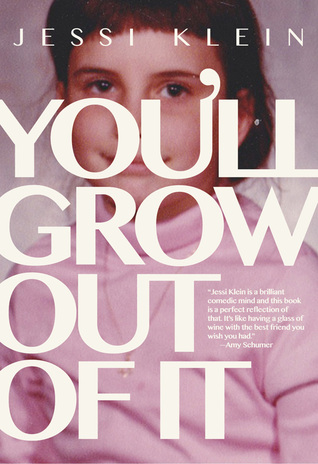
Coming Soon: You'll Grow Out of It


Title: You'll Grow Out of It
Author: Jessi Klein
Publisher: Grand Central
Release Date: 7/12/16
Version Reviewed: digital ARC courtesy of NetGalley
Rating: ★★★

I didn't who Jessi Klein was before picking up this book. Still don't, really. What attracted me to this memoir was book blurb-- a woman who feels like she's on the outside of femininity, looking in. Even though I was hardly a tom boy (or tom man, to use the author's phrase), I also had/have no interested in typical girly things-- and my mother has been in the fits of anxiety about it for the last three decades. I thought I would find Klein's writing relatable and funny. And sometimes I did. But other times I wasn't sure I could stand one more page about the author's depressing sex life and relationships. 

I had sort of a love-hate relationship with this book, chuckling out loud at some parts and left cold by others. Much to my disappointment, only a small portion is about the aforementioned phenomenon of the grown up tom boy. Most of the book is about her failed relationships. All these comedienne memoirs are starting to run together for me. It feels like they've all dated (and complained about) the same exact men. I think I might have enjoyed this book more had I not read Bossypants only a month earlier. There's nothing in here that Tina Fey can't, and didn't, do better.

You'll Grow Out of It is basically a funny rerun of other books.

Wednesday, June 22, 2016

New Release: True Crime Addict


I don't think anyone likes writing one-star reviews. No one picks up a book and thinks, "I really hope I spend the next three to eight hours reading something I don't enjoy." I think the important thing is the lesson the reader takes away from the one-star book. After all, there must be a reason we finish some books and toss aside others. What I took from this book was a profound sense of respect for the privacy rights of the family of the missing. It's not something I'd given much thought to before. I don't think sometimes we, the public, realize how invasive our interest in missing persons cases can be. It's important to know where the line is between having a genuine, harmless interest and being a vulture.

For the most part, I think how I feel about an author should have no bearing on how I feel about their work. The exceptions for that are memoirs and cases where the author's writing has the potential to cause actual harm. True Crime Addiction ticks both boxes. I don't hold back here. I think lowly of James Renner. His behavior toward the Murray family and friends disgusts me, and I'm not impressed with his theorizing. I honestly don't know how this book got published.

Title: True Crime Addict: How I Lost Myself In the Mysterious Disappearance of Maura Murray
Author: James Renner
Publisher: Thomas Dunne Books
Release Date: 5/24/16
Version Reviewed: digital ARC courtesy of NetGalley
Rating: ★

James Renner is a creep. This is a man who posts pictures of random women on his blog, plucked from social media and other sources, and encourages his internet troll army to speculate whether or not they are "really" Maura Murray. This is a man who has called Maura Murray a sociopath, a baseless accusation that in no way suggests Renner cares about the subject of his obsession. This is a guy who drove drunk to simulate Murray's possibly inebriated drive through New Hampshire. He could have killed someone. This is a guy who punches a cop and thinks he's the victim. According to a personality test, he tested as "similar to Ted Bundy." Hmmm.

Despite assuming a position of authority and asserting himself to be an important part of the investigation, Renner has no real press credentials. He's on the outside of this investigation, looking in, demanding answers he's not entitled to and making it up as he goes along.

A large portion of this book focuses on Renner himself-- his serial rapist grandfather, his almost-abduction as a child, his inner demons. I have to say, it's not a boring story. And it's honest. That's more than I can say about the portions about the Murray investigation. Those are less honest. There he relies on inane details fed to him from internet sleuths that he then sensationalizes and puffs up. He treats rumor and innuendo as fact.

Renner stalks Murray's family and friends, and when they won't talk to him he decides it's because they are hiding secrets-- secrets he makes up in his headRenner hints that Maura's father won't talk to him because he's hiding sexual abuse. There's no evidence of that, at all. A friend won't talk to him because she's hiding that she helped Murray escape. There's no evidence of that, at all. Families of the missing are NOT public property. They don't have to answer questions from every Tom and Harry just because. They have no obligation to satisfy curiosities or entertain conspiracy theories. No one owes Renner an interview no matter how badly he wants one. The Murray family clearly does not believe talking to him will help find Maura. They are entitled to make that determination, and I don't disagree with it.

Renner speculates that Maura may have been pregnant. There was birth control pills found in her car at the time of her disappearance, a detail that's pushed aside in favor of veiled hints. Renner isn't shy of portraying Murray as a promiscuous woman with lots of secret men in the shadows. He insists Murray was followed to New Hampshire by a tandem driver. No one saw the headlights or saw the car or heard the car. His theory is that the driver "doubled back" once Murray crashed, very possibly drunk (wine spilled all over the car) and ushered her off to her new life in Canada. It doesn't make a lot of logical sense. If the second car had seen Maura crash, it would have been seen by the eyewitnesses. If it was too far ahead to see the crash, Maura would have needed to contact the driver-- but there is no cell service in that area. Plus, she left her car full of her possessions, things she must have felt were important enough to take to her new life. I'm not saying it's impossible, but it's unlikely enough that a "journalist" like Renner should have the sense not to treat it as fact. 

Maura Murray was not a perfect person. She was, however, by all accounts, a nice girl with flaws. She was in her early 20s and had her whole life ahead of her. Who knows what she could have achieved. James Renner has turned her disappearance into a cottage industry and is banking on it, big time. And goodness knows a tabloid-style story sells. I just feel sorry for the people caught up in the tidal wave of Renner's ego.

Please don't read this book.

Thursday, June 16, 2016

New Release: Street of Eternal Happiness


This is another book I reviewed early in my NetGalley "career," and one of my favorites. I've read a couple books on modern China, and this is the best. It's a great example of non-fiction storytelling.

Title: Street of Eternal Happiness: Big City Dreams Along a Shanghai Road
Author: Rob Schmitz
Publisher: Crown
Release Date: 5/17/16
Version Reviewed: digital ARC courtesy of NetGalley
Rating: ★★★★★

The focus of this book is one single road in Shanghai and its eclectic mix of inhabitants. For years, author Rob Schmitz, an American journalist, lived on the Street of Eternal Happiness with his family. He spent hours wandering up and down the avenue, eating at cafes and ordering off snack carts, visiting local businesses and chatting up his neighbors. Their stories are Shanghai's story.

Schmitz starts by introducing us to a young, optimistic entrepreneur who splits his time selling accordions and running a sandwich shop with an ever-changing menu that does not always include sandwiches. He represents the millions of Chinese who grew up in a post-Mao era and who embrace capitalism with no fear of reprisal. Then there's the owner of the local flower shop, who was part of the 1990s migration from farm to factory. Even though this florist lives in Shanghai, she straddles two worlds between old and new China, obsessed with marrying her sons off to girls from her hometown-- if only bride prices weren't so high these days. There's the elderly woman whose husband runs a pancake shop, and who falls victim to the many ponzi schemes that prey on China's seniors. Through old letters, Schmitz constructs the story of a businessman who was sent to a desolate work camp during the cultural revolution, and how his family chose to embrace the new system rather than mourn his suffering.

Schmitz is an excellent writer and it's impossible not to get sucked into his neighbors' life tales. It's amazing how the Chinese can view their country and their history so differently depending on the lottery of birth. Even husband and wives can't agree whether the remote province where they met was a hell on earth or a paradise overflowing with milk and honey. Every person Schmitz encounters is perusing the "Chinese dream," but none of them agree on just what that is. In modern China, it seems there are as many different realities are there are opportunities.